
Business
Minnesota climatologist says El Niño could impact ice on lakes this winter
By Ravi Patel
Advertisement · Why this ad?
Ravi Patel has a background in economics and journalism, graduated from the University of North Dakota. With four years of experience at local news outlets, he specializes in business trends and economic development in the Grand Forks area.
More from Ravi →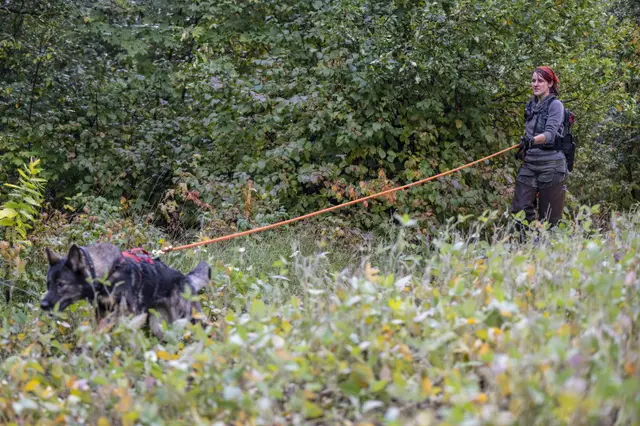
Based on facts, either observed and verified firsthand by the reporter, or reported and verified from knowledgeable sources.
Stern, a 6-year-old German shepherd, collared with a long leash, her nose close to the ground, leads her human partner through the Minnesota woods.
Juliet Flint, holding onto the leash, keeps up the pace. She knows her dog is on a scent track and soon, she has no doubt, Stern will find what she is searching for — a downed deer that ran away after a hunter had shot it. Instead of letting the harvest go to waste lost in the woods, Flint uses her dog, at the hunters request, to track the game animal.
Flint reads her dog and knows that Stern will find success just up ahead, the leaves crunching under her paws, the scent making the female shepherd excited.
Flint is right. Stern leads her owner and the hunter to a downed deer. Now the hunter can harvest his kill and the deer won’t go to waste.
Per usual, Stern did well.
This scenario is typical of an outing with Stern — but it also is atypical, because every day in the woods is a different chapter of the outdoor experience for the dog and her master.
Flint, a big game tracker who recovers harvests for hunters, owns Stern Game Recovery in Bemidji. She’s been tracking for about six years now and says it’s what she plans to do for the rest of her career.
“I love what I do,” she said.
Flint loves what she does because it incorporates working with dogs, going outdoors and being around hunters, some of the people she connects with most. Now 26, she considers herself lucky to have found her lifelong career — all because someone gave her a chance.
Previous to finding her place, Flint worked with canines tracking narcotics before she started doing game recovery.
“I’m not much of an indoor cat,” she said. “That didn't pan out with the kind of gal I grew up to be and so I transitioned from working in narcotics detection to dipping my feet into game recovery, thanks to a tracker that has since retired but from whom I learned a lot when I was first starting out.”
She shadowed her mentor, learning the ropes, and quickly fell in love with tracking.
“Cleary,” she said. “Six years later and I’m still out here doing it as my full-time job. … All of that because another tracker gave me the time of day. I got bit by the bug is how I put it. I got the opportunity to try it once and found it’s what I want to do with the rest of my career.
“It’s not as exciting an origin story as I feel like folks hope for when I tell it to them; everybody wants to know how I got started and I wish I had a better, more super hero answer. But,” in reference to the Spider-Man story, “there was no radioactive spider that bit me.”
Flint, who tracks deer and bears, primarily works with her 6-year-old German shepherd, Stern, but she also has a 6-month-old Belgian malinois who is learning the ropes. Stern is “one of the most certified tracking dogs in the state,” she said. “Only three teams in the entire have passed a tracker level 3 certification and we’re one of them. It’s a nice little piece of paper that shows we know what we’re doing.”
It all begins with the training.
Some people might believe if they adopt a bloodhound and take it out in the woods from time to time that it will naturally know how to track. That’s a misunderstanding a lot of people have, Flint said. She will train a dog for a year and a half to two years before it’s ready to go out in public full time and get the job done.
“It actually takes thousands of hours, on average, of mock training scenarios as well as real life scenarios, what we call layups, where we know an animal is dead, we know where it is, and we set the dog up for success by letting them track that animal knowing there's something for them to find at the end of it.”
There are other times she sets the dog up for failure, testing its will and enhancing its natural instincts.
“You need to sink a lot of training hours into both of those scenarios for training before a dog is really well prepared to go out in the world and work with the general public,” she said.
Part of training includes taking the hooves of a dead deer, strapping those into a special pair of boots — “there’s some pretty swanky equipment that comes with this line of work if you're so inclined to get that far,” she said — and walking a line in the woods mimicking the trail of a mortally wounded deer. Then, after anywhere from 48 to 72 hours, the dog tracks the scent.
There's also backtracks and double-backs, giant loops to only end up back where they started. She said most of the challenge in training is trying to portray real scenarios, similar enough to what the dogs will encounter on a real tracking adventure so they are best prepared for it.
“A lot of the training comes down to trying to set them up for failure a little bit,” she said. “I’ve had my dog do some crazy stuff over the years to prepare them for the kind of crazy stuff that could happen in real-life scenarios when tracking an animal.”
On average, she spends at least a couple of times a week working with the dogs — to keep the German shepherd up to date and to train the Belgian malinois. During the off season, she and Stern will help track nuisance animals for conservation officers.
Over the years, Flint has encountered some people who have expressed interest in doing the same kind of work, but once they learn they’ll have to bust brush for the next couple of calendar years, putting their dog through all sorts of trials, many of them decide they just want to do it during the hunting season. But it's from rigorous and consistent training where a trainer gets the dividend.
“The training is not as glamorous as real-life recoveries, where we have a grip-and-grin (photo) with a 12-point buck,” she said. “But the training is where it really pays off. We spend a ton of time just preparing dogs in the off-season.”
Flint, besides her two dogs, is a one-woman business, but she works closely with a couple of other trackers in the region. Between the three of them, they try to cover hunters from Bemidji to the North Dakota border near Grand Forks and Fargo.
Doug Leier: The balance of managing deer and deer hunting in North Dakota 4d ago Minnesota ATV enthusiast readies for deer opener Nov 7 Safety tips to remember when taking ATVs on a hunt Nov 7 Because hunters never know when a tracker might be needed, Flint said it’s a good idea for hunters to have a tracker in their phone’s contact list so they can easily and quickly call when needed. Sometimes hunters will spend a lot of time trying to find the deer or bear they shot, but never locating it, instead spreading their own scent throughout the woods.
Some hunters have grid searched, spending the better part of two or three days searching blindly, walking everywhere to find their kill. In the process they pick up an invisible scent of pheromones that dogs are trained to track, making it tougher on the canines once on scene.
“That carries a scent everywhere that you can possibly imagine,” she said.
She encourages hunters to stop doing grid searches and instead call for the help of a canine. A trained tracking dog can make all the difference.
Flint said even if hunters never think they're going to need the assistance of a tracking dog, they should still save a local trackers number before going afield – “so you know who to call just in case.”
There are options in the region, she said, including herself and those with whom she sometimes partners, inc
Grand Forks, North Dakota
Business
Saturday, November 14, 2026
7 min
By Ravi Patel
By Ravi Patel
By Lydia Smallwood
By Mark Gilliam